CJC-1295 DAC vs No-DAC: the long and short forms
DAC names a chemical hook that holds a blood protein. Without that hook, the short form leaves much sooner.
CJC-1295 DAC remained in blood for days
At ConjuChem, the company that made CJC-1295, scientists wanted a brief hormone order to last longer. Early tests then followed blood hormones across several days.
DAC is short for drug affinity complex, the name of a chemical hook. The hook catches albumin, a blood protein, and explains the longer stay rather than any health gain.
CJC-1295 DAC is the long form. The shorter form shares part of the name, which is why mix-ups happen [8].
When DAC appears, the drug has the albumin hook. Attached albumin helps CJC-1295 remain in blood longer [2].
No-DAC has changes that slow its breakdown but has no albumin hook [8]. The body therefore clears it much sooner.
Most figures measured over days refer to CJC-1295 DAC. A human study found that half the long-form drug stayed in blood for days.
After repeat shots, IGF-1 stayed high for weeks. In rats, the DAC form caused 4-fold more growth hormone release [1][2].
Those numbers don't describe Modified GRF (1-29), the short form. Applying them there would give you the wrong sense of timing.
The study still found the long form in rat blood
The hooked drug attached to albumin. It caused about 4-fold more growth hormone release in rats and was still in blood past 72 hours [2].
In adults, half the dose was gone after 5.8 to 8.1 days. After repeat shots, IGF-1 stayed above its start for as long as 28 days [1].
The DAC hook accounts for the longer stay
On CJC-1295, the drug affinity complex is the hook added to the long form [2]. It turns a short stay in blood into one lasting days.
Without its hook, CJC-1295 can't attach to albumin. Reading the full name tells you which form a study tested.
Modified GRF (1-29) is the short form
ConjuChem also made a CJC-1295 version without the albumin hook. Sellers call this short form Modified GRF (1-29).
Modified GRF (1-29) may leave within minutes or hours
GRF means growth hormone-releasing factor, the brain's order to the growth gland. Scientists changed four small protein parts, which slows breakdown but doesn't add an albumin hook [8].
The CJC-1295 short form is a lab-made copy of that brain order [8]. It leaves blood more like your body's natural message.
The CJC-1295 no-DAC form can be gone within hours and sometimes within minutes [8]. A timing claim makes little sense unless it names the form.
Modified GRF (1-29) can't attach to albumin
Both forms are changed copies of the same brain order. Each one tells the gland below your brain to send out hormone [2][8].
Only CJC-1295 DAC catches albumin. That hook changes a brief stay into one that lasts days.
A schedule discussed for one form doesn't carry over to the other. Any study or seller needs to state which form was used [8].
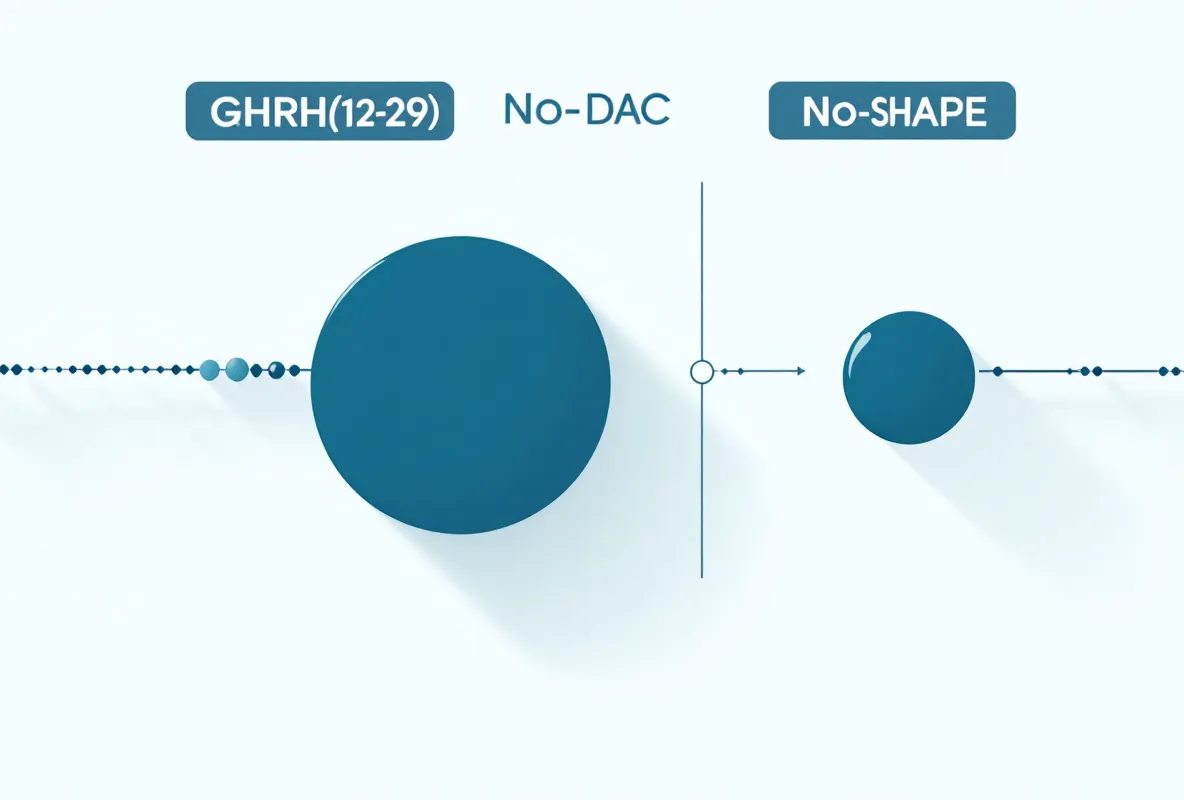
The hook changes both blood time and research timing
ConjuChem started both forms with the same peptide. Only CJC-1295 DAC attaches to albumin, which accounts for its slower exit from blood [1][2][8].
Half the DAC drug was gone after 5.8 to 8.1 days. No-DAC may clear within hours or even minutes.
Because the long form remained for days, researchers could leave days between shots. The short form's much quicker exit makes those timings impossible to swap.
After more than one DAC shot, IGF-1 stayed high for weeks [1]. That IGF-1 result doesn't belong to Modified GRF (1-29).
Human studies tied CJC-1295 DAC amounts to body weight
Early human work used 30 to 90 micrograms per kilogram in shots under the skin [1][3]. One microgram equals a millionth of one gram; per kilogram means body weight set the amount.
Because DAC remained for days, researchers waited between shots [1]. Their timing still doesn't establish a safe schedule for you.
No amount has approval for human care. Fixed figures posted online didn't come from a study comparing treatment groups [7].
The research amount page also explains the short no-DAC form. Plans shared by users aren't tested care plans [7].
CJC-1295 isn't approved for you or anyone else in either form. Neither has an accepted way to take it for an illness.
A time or schedule that omits the full form name leaves you without the main fact, because one number can't fit drugs that leave at such different speeds [8][8]. You need the form name before any timing claim makes sense.